1. Introduction — The New Era of Smarter Home Financing in the UAE
In 2025, the UAE real estate market continues to shine as one of the most resilient, rewarding, and internationally trusted destinations for property ownership. From first-time homeowners in Dubai to global investors eyeing waterfront villas in Abu Dhabi, the dream of owning a home in the Emirates is now more achievable than ever — provided you understand how the UAE mortgage system truly works.
Gone are the days of lengthy, confusing, paper-heavy loan approvals. Today, with the right guidance and expert handling, your mortgage journey can be streamlined, transparent, and financially optimized. Whether you are a UAE resident, non-resident investor, or high-net-worth executive, this comprehensive guide Ricadi Mortgages will walk you through every stage — from initial eligibility to final approval.
2. Understanding the UAE Mortgage Landscape
Before diving into the process, it’s important to understand how the UAE mortgage system operates in 2025.
Mortgage products in the UAE are typically offered local and international banks licensed the Central Bank of the UAE. The prevailing mortgage interest rates (as of Q4 2025) range between 3.75% and 4.5% fixed, depending on tenure and customer profile, with variable-rate options linked to EIBOR (Emirates Interbank Offered Rate).
Banks today are offering:
- Fixed-rate mortgages: Usually fixed for 2, 3, or 5 years (e.g., 3.99% for 3 years, 4.25% for 5 years)
- Variable-rate mortgages: Tied to EIBOR + bank margin, fluctuating with market rates
- Hybrid mortgages: A mix of fixed and variable structures for flexibility
The UAE’s Central Bank has maintained prudent lending norms, which makes the system secure for borrowers and attractive for long-term investors.
3. Step 1 — Evaluate Your Mortgage Eligibility
Your eligibility determines not only whether you qualify for a mortgage but also how much you can borrow and at what rate.
Key Eligibility Criteria:
- Employment Type: Salaried or self-employed (minimum 6 months to 2 years of employment)
- Income Threshold: Minimum AED 10,000–15,000 per month for salaried applicants; higher for self-employed
- Age: Between 21 and 65 years (or retirement age)
- Credit Score: Ideally above 700 (per Al Etihad Credit Bureau)
- Residency Status: Residents and non-residents can both apply, though non-residents may have stricter requirements
LTV (Loan-to-Value) Ratio:
- UAE Nationals: Up to 85% for properties under AED 5 million
- Expat Residents: Up to 80%
- Non-Residents: Typically up to 60–70%
This means you’ll need a 20–40% down payment, depending on your category.
Ricadi Mortgages ensures all clients undergo a comprehensive pre-assessment to determine the best-fit bank, rate type, and tenure based on personal financial goals.
4. Step 2 — Choose the Right Mortgage Type and Tenure
Your mortgage structure can make a significant difference in long-term savings. Let’s explore the major types:
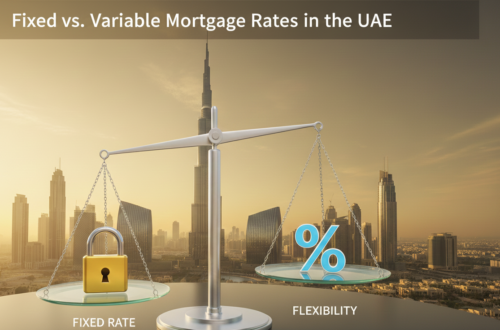
Fixed-Rate Mortgage
- Ideal for buyers seeking stability and predictable EMIs.
- Lock in your rate (3.99–4.25%) for 2–5 years.
- Protects you against rate hikes but may not benefit from rate cuts.
Variable-Rate Mortgage
- Tied to EIBOR (currently around 5.1% with 3-month averaging).
- Offers potential benefit when interest rates fall.
- Typically includes a bank margin (0.75–1.25%).
Hybrid or Buy-Out Options
- Combine initial fixed stability with later variable flexibility.
- Perfect for investors planning to refinance after a few years.
Ricadi’s experts help you model EMI forecasts, simulate rate change impacts, and pick structures that reduce your long-term interest burden.
5. Step 3 — Prepare Your Documentation (Residents vs. Non-Residents)
For UAE Residents
- Valid Emirates ID and passport copy
- Salary certificate or employment contract
- Last 3–6 months of salary slips and bank statements
- Credit report from Al Etihad Credit Bureau
- Property sale agreement or title deed
For Non-Residents
- Passport copy and visa page
- Proof of income (employment letter, tax returns, or company financials)
- 6–12 months of international bank statements
- Power of attorney (if appointing a local representative)
- Developer or seller’s property documents
Ricadi’s team coordinates directly with banks and developers to verify documents, manage translations, and expedite processing — saving weeks of follow-up.
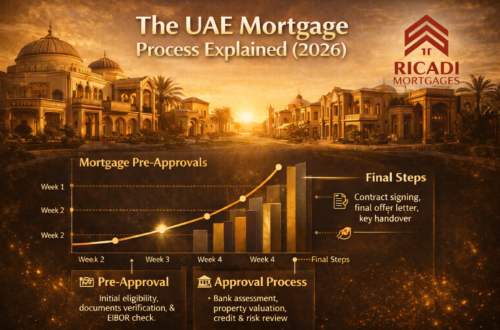
6. Step 4 — Get Pre-Approval (Your Mortgage Green Light)
Mortgage pre-approval is the most strategic step in securing your property quickly.
Why Pre-Approval Matters
- Confirms your borrowing capacity
- Locks in your rate (for 60–90 days)
- Boosts your credibility with sellers
- Simplifies your property search
Timeline: Typically 3–7 working days with Ricadi Mortgages’ streamlined process.
Once pre-approved, you can confidently negotiate your purchase knowing your financing is ready.
7. Step 5 — Property Valuation and Final Approval
After pre-approval and property selection, your bank will appoint a RERA-approved valuer to assess the property’s market value.
Valuation fee: AED 2,500 – AED 3,500 (approx.).
If valuation aligns with the purchase price, the bank issues the final offer letter. Ricadi’s mortgage advisors assist with:
- Reviewing terms for hidden fees
- Coordinating liability settlement (if refinancing)
- Overseeing title deed transfer
Typical Approval Timeline: 5–10 business days post-valuation.
8. Step 6 — Signing, Registration, and Disbursal
The final stage involves executing the mortgage agreement and registering it with the Dubai Land Department (DLD) or relevant emirate authority.
Costs Involved:
- Mortgage Registration Fee: 0.25% of loan amount + AED 290 (DLD)
- Property Registration Fee: 4% of property value
- Processing Fee: 1% (average, varies per bank)
- Insurance: Life + property (annual, typically 0.015–0.025% of amount)
Upon completion, the bank disburses the amount directly to the seller or developer — and you officially become a homeowner.
9. Real-Life Case Scenarios (2025)
Case 1 — The Executive Homebuyer
A corporate finance professional earning AED 45,000/month sought to purchase a townhouse in Dubai Hills for AED 3.2M.
Ricadi arranged an 80% LTV mortgage at 3.99% fixed for 3 years, completing the process in just 11 days.
The client saved over AED 140,000 compared to initial bank quotes.
Case 2 — The Non-Resident Investor
A UK-based entrepreneur wanted to buy a Palm Jumeirah apartment valued at AED 5.5M.
Through Ricadi’s international banking network, he secured 65% financing with a 4.25% fixed rate, eliminating multiple in-person visits.
Funds were disbursed remotely within three weeks.
Case 3 — The Family Refinancing Their Villa
A long-term Dubai resident family paying 5.1% switched through Ricadi’s buy-out program to a 3.85% fixed mortgage, saving AED 3,000 monthly and AED 360,000 across the term.
10. Expert Insights — What Most Borrowers Miss
Most UAE borrowers underestimate:
- The impact of EIBOR movements on floating-rate loans
- Hidden processing fees (banks often waive them under negotiation)
- The power of refinancing when rates drop
- The importance of life insurance integration with mortgage terms
Ricadi Mortgages analyzes all these factors proactively, ensuring every client gets a financially intelligent mortgage aligned with long-term wealth creation.
11. Conclusion — From Dream to Ownership with Confidence
Buying a property in the UAE isn’t just a financial decision — it’s a lifestyle milestone. The process doesn’t have to be daunting.
With trusted experts like Ricadi Mortgages, you gain more than just a loan — you gain clarity, security, and financial control.
Whether you’re a resident, expatriate, or non-resident investor, 2025 offers remarkable opportunities to own, refinance, or expand your property portfolio in the UAE — with the assurance that your mortgage journey will be strategically optimized from start to finish.
12. Top FAQs About Mortgages in the UAE (2025)
1. What is the minimum salary required to apply for a mortgage in UAE?
Most banks require a minimum monthly income of AED 10,000 for residents and AED 15,000–20,000 for non-residents.
2. What is the current average mortgage rate in UAE (2025)?
Rates typically range from 3.75% to 4.5% fixed for 2–5 years. Variable rates depend on EIBOR and bank margins.
3. Can non-residents get a mortgage in UAE?
Yes, major UAE banks offer 60–70% financing to non-residents, subject to additional documentation and eligibility checks.
4. How long does the mortgage approval process take?
With complete documentation, pre-approval can take 3–5 days, and final disbursal within 2–3 weeks.
5. Is refinancing or buy-out a good option in 2025?
Absolutely. With interest rates stabilizing, refinancing can reduce EMIs and total interest cost significantly.
Call to Action:
Looking to secure your mortgage faster and smarter?
Connect with Ricadi Mortgages today for personalized, bank-neutral guidance tailored to your financial goals.