Here’s What Every Expat Buyer Needs to Know About Mortgages There.
Can expats get a mortgage in Abu Dhabi in 2026? Yes, expats can secure mortgages in Abu Dhabi under UAE Central Bank rules: 20% minimum down payment (80% LTV) for first properties under AED 5M, 30% for over AED 5M, and 40% for investments. Buy freehold in zones like Saadiyat Island, Yas Island, Al Reem Island; banks like FAB, ADIB, ADCB offer up to 25-year terms at 3-5% rates. Process takes 5-9 weeks with salary certs, bank statements; AED 2M+ buys qualify for 10-year Golden Visa. Yields hit 9.33% tax-free—ideal for UAE expats.
Expat Mortgage Guide | Abu Dhabi Property 2026 | Ricadi Mortgages
Abu Dhabi’s Property Market Surged 44% in 2025.
Here’s What Every Expat Buyer Needs to Know About Mortgages There.
By the Ricadi Mortgages Team | Dubai & Abu Dhabi, UAE | ricadimortgages.com | Updated Q1 2026
There is a moment every serious property investor living in the UAE eventually arrives at — the moment they stop looking only at Dubai and turn, with fresh eyes, toward Abu Dhabi.
Perhaps it is a conversation with a colleague who quietly bought on Al Reem Island three years ago and has watched the value of that decision compound, year upon year, with the quiet confidence of someone who moved early on the right information. Perhaps it is a number they read and could not quite believe. Perhaps it is the dawning realisation that the capital of the UAE, long regarded as Dubai’s more composed sibling, has been building one of the most compelling and fundamentally sound property markets in the world.
Whatever the moment, the question that follows is almost always the same: can I, as an expat, actually get a mortgage in Abu Dhabi? And if so, how?
The answer is yes. Unequivocally, emphatically yes. And this guide — built on verified data from the UAE Central Bank, ADREC, Bayut, Cavendish Maxwell, and Gulf News — tells you exactly how, and why the opportunity in 2026 is one of the most significant available to expat buyers across the UAE.
What Happened to Abu Dhabi’s Property Market in 2025? The Numbers That Rewrote the Narrative
Before understanding how to finance a property in Abu Dhabi, you must understand what you are entering. Because this is not a market of modest incremental growth. What happened in Abu Dhabi’s real estate sector in 2025 was, any reasonable measure, extraordinary — and the data comes not from promotional material, but from ADREC, the Abu Dhabi Real Estate Centre, the emirate’s own regulatory authority.
- AED 142 Billion
Total Abu Dhabi real estate transactions in 2025 — a record high, representing a 44% increase in value and a 52% surge in volume over 2024. Source: ADREC 2025 Annual Report
Residential unit sales alone reached AED 76.1 billion across 23,600 transactions — a 67% increase in value year-on-year. To contextualise the magnitude of this movement: residential sales in Abu Dhabi grew from approximately AED 19 billion in 2022 to AED 76 billion in 2025. That is a fourfold expansion in three years, supported real population growth of 7.5% in 2024, an economy that expanded 7.7% in Q3 2025 alone, and a regulatory environment that ADREC’s Director General, Engineer Rashed Al Omaira, described as having been deliberately shaped around trust, clarity, and long-term confidence.
Foreign investment accounted for 72% of all real estate investments in Abu Dhabi’s investment zones in 2025, reaching AED 54.13 billion — a 65% increase in value. Investors from more than 100 nationalities participated. Mortgage activity contributed AED 42.7 billion from 17,210 transactions — confirmation that this is not solely a cash-buyer market, but one actively supported institutional finance and accessible home lending.
Abu Dhabi has evolved into a market where capital is not only attracted, but retained through confidence in the system.
Engineer Rashed Al Omaira, Director General, ADREC
The IMF forecasts 6% GDP growth for Abu Dhabi in 2026. Only approximately 6,500 new residential units are expected to enter the market this year — compared to Dubai’s projected 120,000. These are the supply and demand fundamentals that support price stability, yield resilience, and long-term investment confidence.
Can Expats Buy Property in Abu Dhabi? Understanding Freehold Ownership for Foreign Nationals
The most foundational question — and one where outdated information continues to circulate in expat communities across the UAE — is whether foreign nationals can own property in Abu Dhabi at all. The answer in 2026 is unambiguous: yes, within Abu Dhabi’s designated investment zones, expats can purchase freehold property with full ownership rights to both the property and the land it sits on, indefinitely, without a local sponsor or partner.
Freehold ownership grants the right to sell, mortgage, lease, or bequeath the property. It is the strongest form of ownership available in the UAE real estate market, and it is fully available to foreign nationals in Abu Dhabi’s investment zones in 2026.
The Key Freehold Investment Zones in Abu Dhabi for Expat Buyers in 2026
- Saadiyat Island — cultural flagship, home to the Louvre Abu Dhabi; luxury apartments, villas, and branded residences
- Yas Island — entertainment and lifestyle hub; strong tourist demand and consistent rental yields
- Al Reem Island — established mid-market community; strong expat demand, excellent liquidity, metro connectivity
- Al Raha Beach — waterfront living; family-oriented with access to Al Raha schools and amenities
- Al Reef — affordable entry point; highest rental yields in Abu Dhabi at 9.33% (Bayut H1 2025)
- Hudayriyat Island — emerging growth district; AED 12.5 billion in first-year sales; significant long-term potential
- Al Maryah Island — premium commercial and residential; ultra-luxury market with global demand
- Masdar City — sustainable living hub; growing tech and professional tenant population
ADREC Confirms:
Investment zones will receive 79% of all new residential supply scheduled for delivery through 2030. Freehold zones are not peripheral to Abu Dhabi’s growth — they are its central strategic spine.
Can Expats Get a Mortgage in Abu Dhabi in 2026? The Definitive, Regulation-Backed Answer
Yes. The UAE Central Bank’s Mortgage Rulebook governs home lending across all seven emirates. Abu Dhabi is not a separate regulatory universe — it operates under identical LTV ratios, DBR caps, income requirements, and lending standards as Dubai, Sharjah, or any other emirate in the UAE.
Multiple leading banks actively offer competitive mortgage products to expatriate buyers in Abu Dhabi: First Abu Dhabi Bank (FAB), Abu Dhabi Islamic Bank (ADIB), ADCB, Emirates NBD, Mashreq, HSBC, and Standard Chartered. Both conventional and Sharia-compliant Islamic finance products are available, giving expats flexibility to structure financing in alignment with their values and financial planning preferences.
The myth that Abu Dhabi is mortgage-inaccessible for expats is not just incorrect — it is costly. Every month spent renting while this market performs is a month of equity building missed and rental yield foregone.
“The most expensive decisions in real estate are not made in the market. They are made in the mind, from assumptions that were never verified.”
— Adi, Founder, Ricadi Mortgages
What Is the Minimum Down Payment for an Expat Mortgage in Abu Dhabi? Official CBUAE Rules
This is the most searched query among expats considering Abu Dhabi property — and the one where mythology has caused the most damage. Here are the official figures, sourced directly from the UAE Central Bank Mortgage Rulebook, current as of Q1 2026:
| Buyer / Property | Property Value | Min. Down Payment | Max LTV |
|---|---|---|---|
| Expat — 1st Property | Under AED 5M | 20% | 80% |
| Expat — 1st Property | Over AED 5M | 30% | 70% |
| Expat — 2nd / Investment | Any value | 40% | 60% |
| All buyers — Off-Plan | Any value | 50% | 50% |
| UAE National — 1st Property | Under AED 5M | 15% | 85% |
Source: UAE Central Bank (CBUAE) Mortgage Rulebook — current as of Q1 2026. Subject to periodic regulatory review. Always verify with your Ricadi advisor.
The minimum down payment for an expat’s first property in Abu Dhabi valued under AED 5 million is 20%. Not 40%. Not 50%. Twenty percent — and that figure is not a bank’s discretionary policy. It is the maximum LTV mandated the UAE Central Bank, applicable in Abu Dhabi as in every other emirate.
Abu Dhabi Transaction Costs: A Critical Advantage Over Dubai
One structurally important distinction between the Abu Dhabi and Dubai markets that directly affects the total upfront cash requirement is the transfer fee. In Abu Dhabi, the property transfer fee is 2% of the purchase price — precisely half of Dubai’s 4% DLD transfer fee. Mortgage registration in Abu Dhabi is capped at AED 1,000 — significantly lower than Dubai’s 0.25% of loan value.
For a AED 1.5 million apartment on Al Reem Island, the total upfront cash requirement for an expat first-time buyer is: AED 300,000 down payment (20%), approximately AED 30,000 in transfer and mortgage registration fees, plus valuation, legal, and agent costs — bringing the true all-in requirement to approximately AED 360,000 to AED 380,000. Knowable, plannable, and achievable.
Ricadi Mortgage Tip:
The 2% Abu Dhabi transfer fee versus Dubai’s 4% means a saving of AED 30,000 on a AED 1.5M purchase — a material difference that makes Abu Dhabi structurally more accessible for first-time buyers. Factor this into your total cost comparison before deciding between markets.
What Are Abu Dhabi Rental Yields in 2026? Do They Make a Mortgaged Property Cash-Flow Viable?
Yield is the mathematical foundation of any leveraged property investment. Without understanding what a property earns relative to what it costs, the decision to buy on a mortgage cannot be made responsibly. Abu Dhabi’s yield environment in 2026 is among the strongest of any major global city — particularly when combined with tax-free rental income and zero capital gains liability.
| Community | Property Type | Gross Yield | Market Tier |
|---|---|---|---|
| Al Reef | Apartments | 9.33% | Affordable |
| Al Ghadeer | Apartments & Townhouses | 8.45-9% | Affordable |
| Hudayriyat Island | Apartments (Off-plan) | 7.5-8.5% | Emerging |
| Al Reem Island | Apartments | 6.5-7.8% | Mid-Market |
| Yas Island | Apartments & Villas | 6.5-7.5% | Premium |
| Saadiyat Island | Luxury Apartments & Villas | 6.5-7.5% | Luxury |
Sources: Bayut H1 2025 Abu Dhabi Property Report, Cavendish Maxwell Q3 2025, Sands of Wealth 2026 Analysis.
To contextualise: residential rental yields in London average 3% to 5%. New York averages 4% to 6%. Singapore sits at 3% to 4%. Abu Dhabi’s yield environment outperforms all three major global cities — and does so in a jurisdiction with zero property tax, zero capital gains tax, zero income tax on rental earnings, and a vacancy rate of just 4% to 6% across the investment zones.
For a leveraged buyer purchasing a AED 1.5 million apartment on Al Reem Island at 20% down and a 4.5% mortgage over 25 years, the monthly payment is approximately AED 6,600. Al Reem Island one-bedrooms currently achieve AED 70,000 to AED 85,000 per annum in annual rent. At the mid-upper range, the rental income approaches or covers the mortgage payment — while the buyer simultaneously builds equity in an asset that appreciated 20% to 35% over the past two to three years.
Abu Dhabi vs Dubai Mortgage: What Is Actually Different for Expat Buyers?
Among the most frequently searched comparative queries from UAE-based expats is the practical difference between securing a mortgage in Abu Dhabi versus Dubai. The structural answer is: less than most people believe — and where differences exist, they frequently favour Abu Dhabi.
What Is the Same in Both Markets
- CBUAE Mortgage Rulebook: identical LTV ratios, maximum tenor of 25 years, and DBR cap of 50% across all emirates
- Eligibility criteria: same income requirements, documentation standards, and age limits apply
- Lenders: major national banks (FAB, Emirates NBD, ADCB, Mashreq, HSBC) operate in both markets
- Islamic finance: fully available in both emirates through ADIB, Dubai Islamic Bank, and others
Where Abu Dhabi Has a Structural Advantage
- Transfer fee: 2% in Abu Dhabi versus 4% DLD fee in Dubai — AED 30,000 savings on a AED 1.5M purchase
- Mortgage registration: capped at AED 1,000 in Abu Dhabi — significantly lower than Dubai’s 0.25% of loan value
- New supply: approximately 6,500 units entering Abu Dhabi’s market in 2026 versus Dubai’s 120,000 — driving stronger price stability and yield compression resistance
- Entry pricing: median Abu Dhabi residential transaction at AED 1.48M versus higher median values in comparable Dubai lifestyle communities
- Market maturity: ADREC’s regulatory framework, established in 2023, is among the most transparent and data-driven in the region
Where Dubai Has an Advantage
- Resale liquidity: Dubai’s larger, deeper transaction market offers broader and faster exit options
- International recognition: Dubai’s global real estate brand attracts a wider pool of international buyers for resale
- Transaction velocity: average time on market in Dubai is shorter in many communities
| The Ricadi Perspective:The right market is not Dubai or Abu Dhabi universally — it is the market that aligns with your financial strategy, income profile, and investment horizon. Ricadi Mortgages provides a free, personalised comparison for clients considering both markets. |
The Golden Visa Advantage: How an Abu Dhabi Property Purchase Unlocks 10-Year UAE Residency
Purchasing property in Abu Dhabi valued at AED 2 million or above qualifies the buyer for the UAE’s 10-year Golden Visa — one of the most significant long-term residency instruments available to foreign nationals anywhere in the world.
The Golden Visa requires no employer sponsorship, carries no annual renewal burden tied to employment, and extends automatically to the holder’s spouse and dependent children. It allows extended periods in the UAE without the standard 180-day continuous presence requirement. In 2026, the AED 2 million threshold is accessible in premium units on Al Reem Island, Yas Island, and Saadiyat Island — making Golden Visa eligibility achievable without reaching into the ultra-luxury price bracket.
For expats who view Abu Dhabi not merely as an investment but as a long-term home — the Golden Visa pathway transforms a property transaction into a decade of residency stability, family security, and wealth building, all under the same roof. It is a benefit with no equivalent in most major global property markets.
Golden Visa holders frequently receive preferential consideration from UAE mortgage lenders, reflecting the long-term commitment to UAE residency that the visa represents.
Step--Step: How to Apply for a Mortgage in Abu Dhabi as an Expat — With Ricadi Mortgages
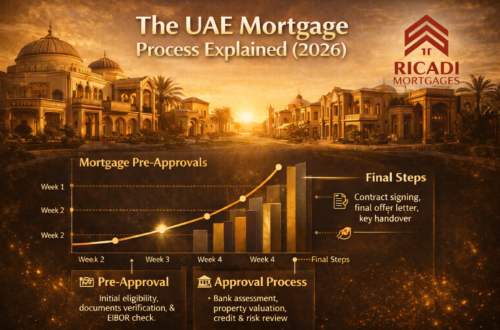
The process, for a well-prepared applicant working with an experienced broker, is considerably more structured and straightforward than most expats anticipate. Total timeline from first consultation to keys in hand: typically five to nine weeks.
- Step 1 — Free Initial Consultation: Ricadi assesses your income, employment profile, nationality, target community, and financial position across all relevant lenders simultaneously. One 30-to-60-minute conversation produces a complete picture. No bank visits. No guesswork.
- Step 2 — Document Preparation: Ricadi provides a precise checklist tailored to your profile. Salaried expats typically require: passport, UAE residency visa, Emirates ID, salary certificate, three to six months of payslips, three to six months of bank statements, and an existing liability letter. Self-employed applicants provide two years of audited accounts, business bank statements, and trade license documents. Ricadi reviews every document before submission to prevent processing delays.
- Step 3 — Mortgage Pre-Approval: Submitted to the most suitable lender(s). Pre-approval is typically issued within three to seven business days and is valid for 60 to 90 days. This formal confirmation of your borrowing capacity gives you the negotiating position of a confirmed buyer.
- Step 4 — Property Identification and Valuation: Once you select your property, the bank commissions an independent valuation. Full mortgage approval typically follows within five to ten business days.
- Step 5 — Completion: Ricadi coordinates with the Abu Dhabi Land Department (ADLD), conveyancer, and all parties through to registration and key handover. From offer letter to keys: typically two to four weeks.
| No Advisor Fees Charged to Borrowers:Ricadi Mortgages charges no upfront or advisory fees to borrowers. Our compensation is provided the banking institutions we place business with — the industry-standard model across UAE mortgage brokerage. You receive expert, full-service guidance at no additional cost. |
Frequently Asked Questions: Abu Dhabi Expat Mortgages — Answered Ricadi
Can expats get a mortgage in Abu Dhabi in 2026?
Yes. UAE Central Bank mortgage regulations apply across all emirates. Expats can borrow up to 80% LTV for a first property under AED 5M from major banks including FAB, ADIB, ADCB, and Emirates NBD.
What is the minimum down payment for an expat mortgage in Abu Dhabi?
The minimum down payment is 20% for a first property under AED 5 million, as mandated the CBUAE Mortgage Rulebook. For properties over AED 5M, the minimum is 30%. For investment or second properties, 40%.
What are the best freehold areas in Abu Dhabi for expats to buy property?
In 2026, the top freehold investment zones for expats include Saadiyat Island, Yas Island, Al Reem Island, Al Raha Beach, Al Reef, Hudayriyat Island, Al Maryah Island, and Masdar City. All allow 100% freehold ownership for foreign nationals.
How does an Abu Dhabi mortgage differ from a Dubai mortgage?
The CBUAE Mortgage Rulebook is national — LTV ratios and eligibility rules are identical in both emirates. Key Abu Dhabi advantages: 2% transfer fee (vs Dubai’s 4%), mortgage registration capped at AED 1,000, lower property prices in comparable communities, and only ~6,500 new units entering the market in 2026 vs Dubai’s 120,000.
Can I get a Golden Visa buying property in Abu Dhabi?
Yes. Purchasing property in Abu Dhabi valued at AED 2 million or above qualifies for the UAE’s 10-year Golden Visa, extending to spouse and dependent children. This threshold is achievable in premium communities on Al Reem Island, Yas Island, and Saadiyat Island.
What rental yields can I expect on Abu Dhabi property in 2026?
Rental yields range from 6.5% (Saadiyat Island and Yas Island premium units) to 9.33% (Al Reef affordable apartments), according to Bayut H1 2025 data. Combined with zero property tax and zero capital gains tax, these yields outperform most major global property markets.
A Final Word: The Question Is Not Whether Abu Dhabi Is Worth It
ADREC’s data is unambiguous. The IMF’s forecasts are supportive. The regulatory framework is among the most transparent in the region. The yields are globally competitive. The Golden Visa pathway is real. The mortgage access for expats is confirmed.
Abu Dhabi’s 2025 performance was not accidental, and the conditions that produced it have not disappeared. Supply remains constrained at approximately 6,500 units in 2026. Population growth continues. Foreign direct investment is accelerating. Mortgage activity reached AED 42.7 billion — confirming that finance is flowing freely into a market that has demonstrably earned institutional confidence.
For expats who have been watching from the sidelines — aware of the numbers, uncertain of their own eligibility — this guide exists to be definitive: you are eligible. The down payments are achievable. The process is straightforward. The opportunity, assessed with clear eyes and the right advice, is genuinely significant.
“Do not wait to buy real estate. Buy real estate and wait.”
— Will Rogers, American Actor and Commentator
The question is not whether Abu Dhabi is worth it. The question is when you will make the call.
Ricadi Mortgages is ready when you are.
| Ready to Finance Your Abu Dhabi Property?Speak to a Ricadi Mortgage Expert Today — Free Consultation, No Obligation20+ Lenders Compared | Dubai & Abu Dhabi | 40+ Nationalities Servedricadimortgages.com | +971 56 364 6906 | Available 24/7Simplify. Secure. Succeed. |
About Ricadi Mortgages
Ricadi Mortgages is Dubai and Abu Dhabi’s trusted full-service mortgage brokerage. Founded Adi, one of the UAE’s most recommended mortgage advisors, Ricadi Mortgages provides free, independent, expert guidance to expat residents, non-residents, self-employed professionals, and property investors across the UAE. Services include purchase mortgages, refinancing, equity release, investment property finance, and pre-approval consulting. 40+ nationalities served. Available 24/7 at ricadimortgages.com or +971 56 364 6906.
Sources: ADREC 2025 Annual Real Estate Market Report, UAE Central Bank (CBUAE) Mortgage Rulebook, Bayut Abu Dhabi Property Report H1 2025, Cavendish Maxwell Q3 2025 Abu Dhabi Residential Market Report, Gulf News, The National, IMF UAE Economic Outlook 2026, Sands of Wealth Abu Dhabi Rental Yield Analysis January 2026.
Focus Keyword: Expat mortgage Abu Dhabi | Tags: Abu Dhabi property investment 2026, can expats buy property Abu Dhabi, Abu Dhabi mortgage down payment, Abu Dhabi freehold zones expats, mortgage Abu Dhabi vs Dubai, Golden Visa Abu Dhabi property, Ricadi Mortgages Abu Dhabi, best mortgage broker Abu Dhabi