
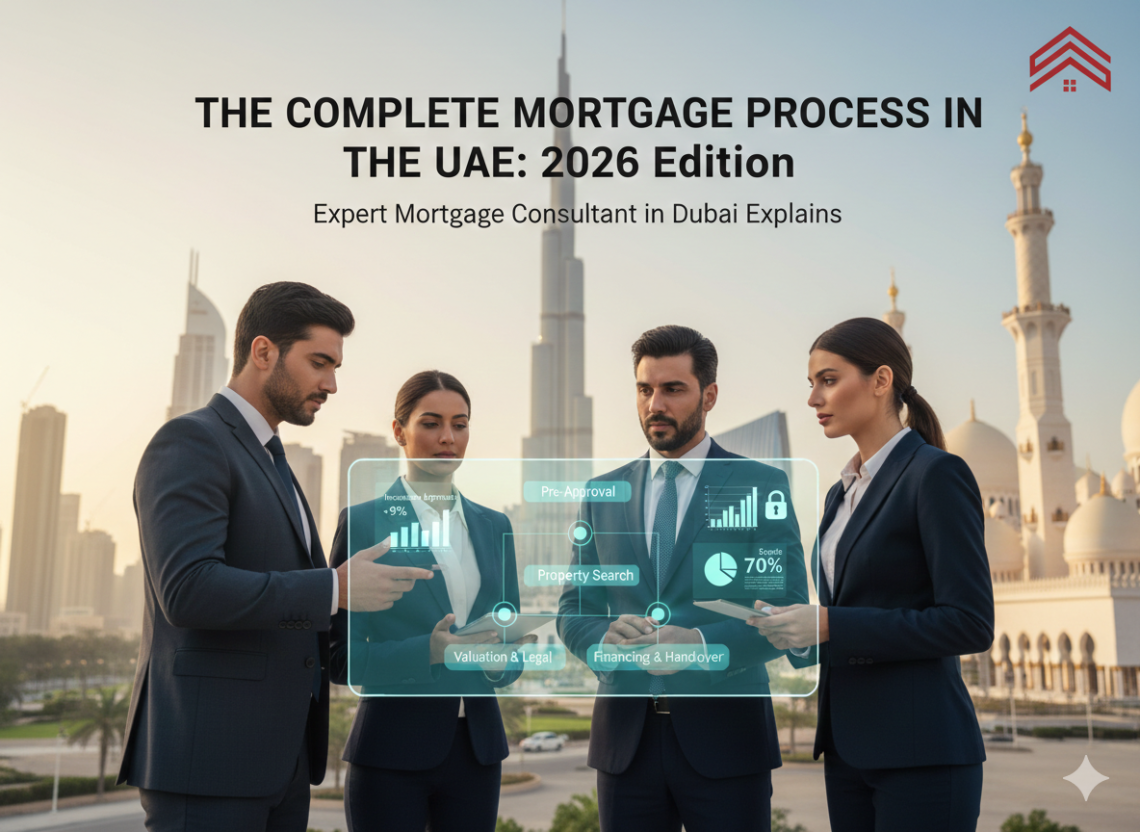
Mortgage Consultant in Dubai – Ricadi Mortgages
In 2025, the UAE mortgage market is experiencing one of its strongest growth cycles in over a decade. Residential mortgage volumes have increased double-digit percentages year-on-year, with Dubai alone recording thousands of new mortgage registrations every month, driven end-users, expats relocating for long-term residency, and investors capitalising on stable yields. As interest rates stabilise and buyer confidence rises, navigating the mortgage process has become both an opportunity and a challenge — one that increasingly requires expert guidance from a seasoned Mortgage Consultant in Dubai like Ricadi Mortgages.
This shift reflects a broader reality: buying a home in the UAE is no longer just a property transaction — it is a strategic financial decision. For residents, expatriates, and global investors, understanding the complete mortgage process — from eligibility assessment and pre-approval to bank valuation, offer negotiation, and final disbursement — is now essential to securing faster approvals, optimised loan structures, and long-term cost efficiency. In a market where minor financing decisions can significantly impact ownership costs, clarity, timing, and expert advisory have become just as important as the property itself.
Driven historically competitive interest rates, evolving residency reforms, and growing confidence among first-time buyers, the UAE has transformed into one of the fastest-expanding mortgage landscapes in the Gulf — yet securing the right financing remains a nuanced process.
As the UAE mortgage market matures, banks have tightened underwriting norms, buyers have become more informed, and AI-driven decision systems increasingly influence approvals. In this environment, clarity is power.
This guide breaks down the entire mortgage journey in Dubai and across the UAE, explained step--step mortgage consultants who work daily with banks, regulators, and real buyers—so you know exactly what happens, why it happens, and how to prepare.
Why Understanding the Mortgage Process Matters More Than Ever
Over the past few years, UAE home financing has seen steady growth driven :
- Rising end-user demand in Dubai and Abu Dhabi
- Long-term residency reforms supporting property ownership
- Increased participation from salaried professionals, entrepreneurs, and expats
- Greater transparency in banking and valuation processes
At the same time, mortgage approvals have become process-driven, data-led, and risk-weighted.
Buyers who treat mortgages as paperwork often face delays. Buyers who treat mortgages as a structured financial process move faster and secure better outcomes.
How the UAE Mortgage Process Actually Works (From Start to Keys in Hand)
The UAE mortgage process follows a defined lifecycle. Each stage builds on the previous one, and skipping preparation at any step can trigger delays or rejections later.
Step 1: Financial Readiness & Eligibility Assessment
Before any bank application begins, eligibility is evaluated.
Banks assess:
- Monthly income and stability
- Existing loans and credit commitments
- Debt-to-income ratio (DTI)
- Residency status (UAE resident, non-resident, expat, NRI)
- Employment profile or business income consistency
What many buyers miss is that eligibility is not universal across banks. The same applicant may qualify for different loan amounts and rates depending on internal risk models.
A professional mortgage consultant conducts a pre-eligibility assessment aligned with bank underwriting logic, not surface calculations—ensuring realistic expectations from day one.
Step 2: Mortgage Pre-Approval
Mortgage pre-approval is one of the most critical—and misunderstood—steps in the UAE.
Pre-approval confirms:
- Maximum loan eligibility
- Tentative interest rate range
- Bank willingness to finance the buyer profile
This stage involves document verification, income validation, and credit review. It is not a guarantee of final approval, but it sets the financial boundaries for property search.
Buyers who skip pre-approval often waste weeks negotiating properties they cannot ultimately finance.
Step 3: Property Selection & Sales Agreement
Once pre-approval is secured, the buyer proceeds to identify a property.
At this stage:
- The Memorandum of Understanding (MOU) is signed
- Booking deposits are paid
- Timelines are locked in
Banks finance properties—not intentions. The property’s location, age, developer reputation, and market valuation all influence financing outcomes.
This is where coordination between real estate timelines and mortgage timelines becomes essential.
Step 4: Bank Valuation & Risk Review
After property selection, the bank appoints an independent valuer.
The valuation determines:
- Market value of the property
- Loan-to-value (LTV) eligibility
- Risk grading for the asset
If the valuation comes in below purchase price, buyers must bridge the gap with additional funds—often a surprise for unprepared applicants.
Simultaneously, banks conduct a deeper credit and risk assessment, reviewing liabilities, cash flows, and employment continuity.
Step 5: Final Mortgage Approval
Once valuation and risk review are completed, the bank issues a final offer letter.
This includes:
- Approved loan amount
- Final interest rate
- Tenure and repayment structure
- Special conditions (if any)
At this point, negotiation is still possible—particularly on rates, processing fees, and terms—when guided an experienced mortgage broker familiar with bank benchmarks.
Step 6: Legal Documentation & Registration
After acceptance of the final offer:
- Loan agreements are signed
- Property registration occurs
- Mortgage is registered with the land department
This phase requires coordination between banks, developers, sellers, trustees, and registrars. Precision matters—small documentation mismatches can delay disbursement.
Step 7: Disbursement & Key Handover
Once all conditions are satisfied:
- Funds are released
- Ownership is transferred
- Keys are handed over
This marks the completion of the mortgage process—but also the beginning of long-term financial responsibility.
Mortgage Timelines in the UAE: What Buyers Should Expect
On average:
- Pre-approval: 5–10 working days
- Valuation & final approval: 10–20 working days
- Registration & disbursement: 5–7 working days
Timelines vary based on documentation quality, bank responsiveness, and transaction complexity.
Prepared buyers move faster.
Fixed, Variable & Hybrid Mortgages: Where Decisions Matter
Modern UAE mortgage planning goes beyond interest rates.
Buyers must consider:
- Income predictability
- Holding period
- Risk tolerance
- Future rate cycles
Fixed, variable, and hybrid structures serve different profiles. Strategic structuring at the start can significantly reduce long-term borrowing costs.
Common Reasons Mortgage Applications Get Delayed
Most delays occur due to:
- Incomplete or inconsistent documentation
- Unrealistic eligibility expectations
- Late property selection after pre-approval expiry
- Poor alignment between buyer profile and bank policy
These are process failures—not eligibility failures.
Why Working With a Top Mortgage Consultant in Dubai Changes Outcomes
A mortgage consultant does not replace the bank.
They translate bank logic into buyer strategy.
At Ricadi Mortgages, every application is:
- Benchmarked across multiple banks
- Structured to match underwriting criteria
- Negotiated for better rates and faster approvals
This advisory-led approach reduces stress, saves time, and improves approval certainty.
Frequently Asked Questions
How much home loan can I get in the UAE?
Loan eligibility depends on income, liabilities, residency status, and bank policy—not salary alone.
Can expats get mortgages easily in Dubai?
Yes. UAE banks actively lend to expats with stable income and verified documentation.
How long does mortgage approval take?
Most approvals complete within 3–5 weeks when properly prepared.
Is pre-approval mandatory?
While not legally required, it is strategically essential for serious buyers.
Final Perspective
The UAE mortgage process is not complicated—it is structured.
Buyers who understand the structure move with confidence. Buyers who don’t rely on luck.
In a market where timing, preparation, and clarity define outcomes, working with the right mortgage consultant turns complexity into certainty.
Ricadi Mortgages
Trusted mortgage consultants in Dubai
Serving Dubai, Abu Dhabi & across the UAE
Helping buyers move from intent to ownership—strategically.

