Key Takeaways
• Mortgage rates in the UAE range between 3.9% and 5.5%
• Expats can finance up to 80% property value
• Comparing multiple banks significantly reduces interest costs
• Working with a mortgage consultant in Dubai improves approval chances
What Are the Best Mortgage Rates in the UAE Right Now?
Mortgage rates in the UAE currently range between 3.9% and 5.5%, depending on the bank, property value, and borrower profile. Leading banks in Dubai and Abu Dhabi offer both fixed and variable home loan options for residents and expats.
| Bank | Starting Mortgage Rate | Max LTV | Best For |
|---|---|---|---|
| Emirates NBD | 3.99% | 80% | Expats |
| HSBC UAE | 4.10% | 75% | High income buyers |
| ADCB | 4.15% | 80% | Residents |
| Mashreq Bank | 4.25% | 75% | Quick approvals |
| Dubai Islamic Bank | 4.30% | 80% | Islamic financing |
The UAE mortgage market is highly competitive and closely tied to global and Central Bank policies. With the dirham pegged to the US dollar, local mortgage rates tend to follow US Fed trends.
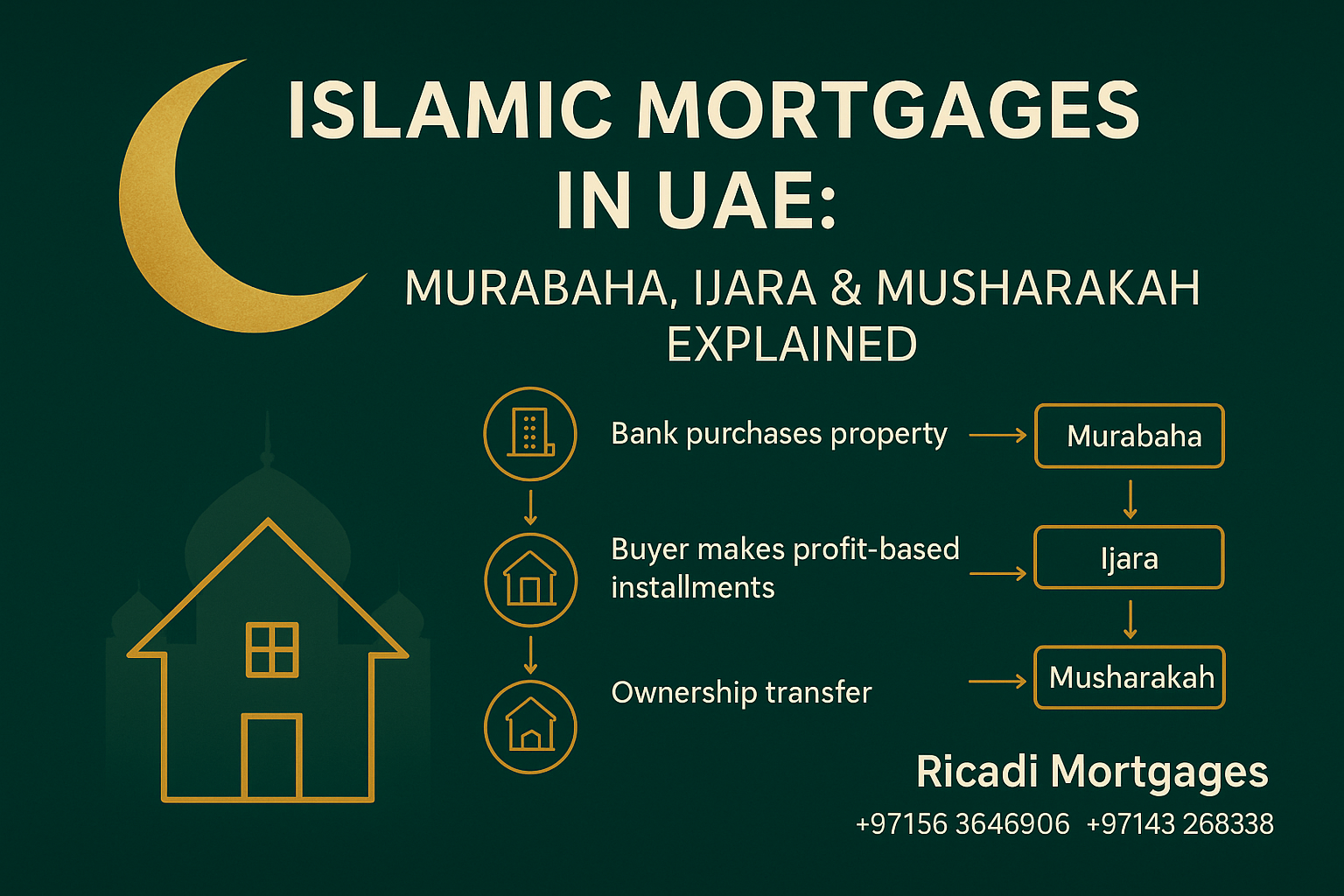
Many banks offer both conventional and Shariah-compliant (Islamic) mortgages: in the latter, the bank buys the home and sells or leases it to you without charging interest (riba). For example, Emirates Islamic’s Manzili and Dubai Islamic Bank’s home finance products use this profit-based model, avoiding interest through Murabaha or Ijara contracts.
Residential vs Commercial Mortgages in the UAE
Understanding the key differences between residential and commercial mortgages is crucial for property buyers in the UAE. Here’s a clear breakdown:
Residential Mortgages
Primarily intended for individuals purchasing homes to live in.
- Loan-to-Value (LTV) Limits:
- Nationals: Up to 85% financing for properties valued at or below AED 5 million.
- Expats: Up to 80% financing for the same bracket.
- Nationals: Up to 85% financing for properties valued at or below AED 5 million.
- Down Payment Requirements:
- 15–20% of the property value for homes ≤ AED 5 million.
- For properties priced above AED 5 million, LTV reduces to 70–75%, so the buyer must pay 25–30% upfront.
- 15–20% of the property value for homes ≤ AED 5 million.
Commercial & Investment Mortgages
Used for purchasing properties meant for rental income or business operations (e.g., offices, warehouses, shops).
- Stricter Lending Terms:
- Expat investors are typically required to make a 35–40% down payment.
- Nationals usually contribute around 35% as a down payment.
- Expat investors are typically required to make a 35–40% down payment.
- Additional Requirements:
- Detailed business plans and proof of income are mandatory for loan approval.
- Commercial lenders are more cautious due to higher risks associated with non-residential properties.
- Detailed business plans and proof of income are mandatory for loan approval.
Incentives for Investors
- 10-Year UAE Golden Visa: Granted for property investments of AED 2 million or more, making real estate an attractive long-term asset.
You will learn more on UAE mortgage rules-
• UAE mortgage rules explained
• Fixed vs variable mortgage rates UAE
• Why use a mortgage broker in UAE
UAE Residential Market Strength
Demand remains robust in the UAE’s residential sector. For instance, Abu Dhabi recorded approximately 3,100 home sales in H1 2025, following an already high post-pandemic performance. Developers delivered nearly 9,400 new residential units in Q1 2025, indicating strong supply-side activity.
[See Chart: Quarterly Residential Sales in Abu Dhabi, 2023–2025]
The accompanying chart highlights steady transaction volumes, particularly in the ready unit segment — a clear sign of ongoing buyer confidence.
These sustained sales figures reinforce the urgency of securing competitive mortgage rates. With both demand and supply rising, the cost of financing (mortgage interest rates, LTV ratios, etc.) becomes a deciding factor in long-term affordability.
Data Source: GlobalPropertyGuide, 2025

Dubai Housing Completions
In early 2025, Dubai’s supply pipeline surged – nearly 9,400 residential units completed in Q1 (a +4.4% year-on-year jump). As the graph shows, quarterly completions are near two-year highs. More supply means more homes for buyers, but it also sustains competition among banks to offer attractive loans.
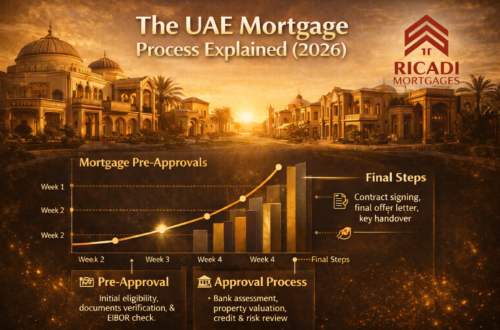
With 3-month EIBOR at roughly 4.3% mid-2025, many fixed-rate mortgage deals now hover near 3–4%. For example, lenders advertise one-year fixed rates at about 3% (Standard Chartered at 2.99%) or three-year fixes near 3.2–3.5% (HSBC’s ~3.24% or Emirates Islamic’s 3.49%). In short, rates are near historic lows, so savvy borrowers should compare deals and lock in financing before any uptick.
Mortgage Types: Fixed, Variable & Hybrid
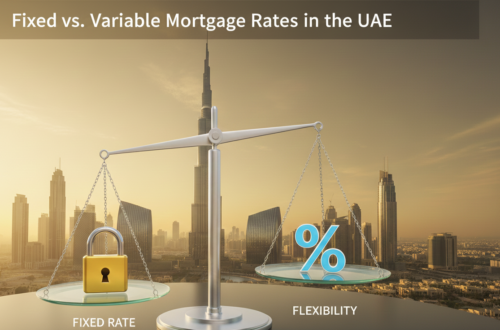
Choosing the right mortgage type is fundamental to your financial stability, especially in the dynamic UAE market. Below is a breakdown of the three core mortgage types available to both residents and expats:
1. Fixed-Rate Mortgage
A fixed-rate mortgage locks in your interest rate for a specified term, usually ranging from 1 to 5 years.
Key Highlights:
- Stable monthly payments: Ideal for long-term planners who want predictability.
- Protection against rate hikes: Safeguards you during volatile economic conditions.
- Limited flexibility: Less favorable if market rates fall during your term.
Best For: Homebuyers who plan to stay in the property long-term and want to shield themselves from fluctuating rates.
2. Variable-Rate Mortgage (Floating Rate)
This type of mortgage is tied to a benchmark rate like EIBOR (Emirates Interbank Offered Rate) and can change periodically.
Key Highlights:
- Potential for lower rates: Beneficial if interest rates decline.
- Greater risk exposure: Monthly payments can rise unexpectedly.
- Often offered with initial discounts: Lower intro rates make it appealing in the short term.
Best For: Buyers comfortable with risk or planning a shorter stay in the UAE who want to capitalize on possible rate drops.
3. Hybrid Mortgage (Fixed + Variable)
Hybrid mortgages combine the security of fixed rates with the flexibility of variable terms. Typically, the initial term is fixed (e.g., 2 years), followed a variable rate phase.
Key Highlights:
- Best of both worlds: Stability upfront, flexibility later.
- Customizable terms: Some lenders allow tailored structures.
- Gradual exposure to risk: Offers a balanced transition for first-time buyers.
Best For: Expats uncertain about their long-term stay, seeking initial stability with future flexibility.

Mortgage Rate Trends in UAE (August 2025)

Pro Tip: If you’re an expat evaluating tenure and cost sensitivity, hybrid mortgages are a growing trend among UAE lenders, offering flexibility and peace of mind.
Current Mortgage Market Trends
Today’s advertised rates reflect fierce competition. In practice, the lowest fixed offers in 2025 are around the mid-3% range. For example:
- Standard Chartered (UAE) advertises a 1-year fixed home loan from 2.99% p.a..
- HSBC UAE offers a 3-year fixed option at about 3.24% p.a. (reducing).
- Emirates Islamic Bank (Manzili) advertises ~3.49% p.a. for its 3-year flat-rate loan.
- Dubai Islamic Bank’s home loan starts at 3.75% p.a. (profit rate).
By contrast, conventional banks like ADCB or Emirates NBD have fixed rates closer to 4–5%, reflecting different loan programs and client profiles. Overall, borrowers now see historically low deal pricing, especially on short-term fixes. (By government rule, higher-risk borrowers or larger loans may pay higher margins on top of EIBOR.)
What Influences Mortgage Rates in the UAE?
Mortgage rates in the UAE are shaped a blend of global market dynamics and local economic conditions. At the core lies the Central Bank of the UAE’s policy, which is closely aligned with U.S. Federal Reserve decisions. When the Fed adjusts rates, the UAE often follows suit — directly influencing borrowing costs.
Key macroeconomic factors include:
- Oil price fluctuations: As a major oil-producing nation, UAE’s economic liquidity and investor confidence are tied to oil trends.
- Inflation outlook: Rising inflation can trigger rate hikes, while a stable or declining outlook may ease borrowing conditions.
- Property market demand: When demand surges, banks may offer competitive rates to gain market share.

But it’s not just about the economy — your personal profile matters too. High-income earners, UAE nationals, and applicants with strong credit histories are often eligible for preferential rates. Additionally, banks enforce a Total Debt Burden Ratio (TDBR) cap, typically limiting total monthly debt obligations to 50% of your income — ensuring your mortgage remains affordable in the long term.
Understanding these factors helps you time your mortgage decision wisely — and secure the most favorable terms available.
Top 5 UAE Banks for Mortgage Rates (2025)
The following banks currently stand out for low advertised home loan rates in the UAE (numbers as of mid-2025):
- Standard Chartered (UAE) – Offers one-year fixed home loans from 2.99% p.a., followed a 3‑month EIBOR‑based rate. (Requires salary transfer and ~80% LTV for nationals, 75% for expats.)
- HSBC UAE – Its New Home Loan has a reducing-rate starting at 3.24% p.a. (fixed for three years, then 3‑month EIBOR). HSBC typically lends up to 80% of the property value.
- Emirates Islamic Bank (Manzili) – Shariah-compliant Manzili mortgage from 3.49% p.a. (3-year fixed, flat rate). Offers up to 85% financing for UAE nationals (80% for expats).
- Dubai Islamic Bank (DIB) – Islamic home finance with profit rates starting at 3.75% p.a. (fixed/variable hybrid products). Typically up to ~85% financing.
- Abu Dhabi Islamic Bank (ADIB) – Home Finance from 3.99% p.a. (three-year fixed). After the fixed term it reverts to 1‑month EIBOR+1.79%. ADIB lends up to 85% of the property value.

Each of these lenders also has sizable foreign-currency/Islamic mortgage portfolios. Borrowers should verify current deals, as rates can change with market movements. The key takeaway is that fixed introductory rates near 3% are available, well below many banks’ longer-term averages.

The table above highlights the starting rates and LTV limits for these top lenders. (Sources: lenders and recent mortgage rate surveys.) Note that borrowing capacity and additional fees (processing, valuation, etc.) will vary bank. In practice, qualifying customers with UAE bank accounts can often finance 80–85% of the home’s value, as shown.
Qualifying for a UAE Mortgage & Your Next Steps
Before securing a competitive mortgage rate in the UAE, it’s important to understand the qualification criteria and prepare the necessary documentation. Here’s what you need to know:
Basic Eligibility Requirements
For Expats:
- Minimum monthly salary: AED 10,000–15,000
- Employment history: 6–12 months with current employer
- Credit score: Etihad Credit Bureau score of 650+
For UAE Nationals:
- Lower salary thresholds may apply
- Similar credit and employment checks
General Lending Rules:
- Your total monthly debt payments (including the new mortgage) should not exceed 50% of your income
- A stable income and clean credit history are essential
Required Documentation
Prepare the following documents to speed up the process:
- Valid passport and Emirates ID
- Residence visa
- Recent salary slips and bank statements
- Employment letter (on company letterhead)
- Tenancy contract or property ownership documents
- For self-employed: Trade license, audited financials, and proof of income
Loan-to-Value & Down Payment Guidelines
Lenders determine how much you can borrow based on your profile:
- UAE Nationals: Eligible for up to 85% of the property value
- Expats: Typically allowed up to 80%
- Down payment: Usually 15–20% for residential properties; higher for commercial or investment loans
Tip: Plan your down payment in advance, as this is a key approval factor.
What Happens After You Apply
- Pre-assessment: The bank evaluates your debt capacity and creditworthiness
- Pre-approval/Mortgage Promise: A formal offer is issued if you qualify
- Property Finalization: Use the bank’s offer to complete the sale and register the mortgage
Why Many Buyers Work With a Mortgage Broker in Dubai
Homebuyers comparing mortgage rates often realize that the lowest rate advertised banks is not always the rate offered after profile assessment.
Mortgage advisors can compare multiple banks simultaneously and negotiate better terms.
Independent mortgage specialists such as Ricadi Mortgages help buyers:
• compare mortgage rates across lenders
• improve approval chances
• simplify documentation and approvals
Ready to Take the Next Step?
Let our expert mortgage advisors guide you through the process:
✔️ Compare offers from top UAE banks
✔️ Get a free eligibility check and personalized consultation
✔️ Use our [online mortgage calculator] to estimate your loan amount
✔️ Receive full support with document preparation and lender coordination
Contact us today to simplify your mortgage journey and secure the best rates available.
In Summary: 2025 Is the Moment to Act
With top banks like HSBC, Standard Chartered, Emirates Islamic, DIB, and ADIB offering mortgage rates below 4%, 2025 presents a golden window for high-intent homebuyers in the UAE. Whether you’re considering fixed or variable rates, now is the time to compare your options, understand key differences in fees and flexibility, and ensure you meet the basic eligibility criteria — including income thresholds, down payment requirements, and supporting documentation.
Acting now could mean locking in one of the most borrower-friendly deals in recent years.
Don’t leave it to chance. For personalized guidance, fast-track approvals, and access to the most competitive mortgage solutions, connect with Ricadi Mortgages today. Our team of experts will assess your profile, match you with the right lender, and handle all paperwork — so you can move forward with confidence.
Not sure which bank will approve your mortgage?
Get a free mortgage eligibility check from experts in Dubai.
Schedule your free consultation now or try our online mortgage calculator to discover how much you can borrow.
Let Ricadi Mortgages make your home financing journey seamless, strategic, and successful.
FAQs About Mortgage Rates in the UAE
1. Which banks offer the most competitive mortgage rates in the UAE in 2026?
Mortgage rates in the UAE vary depending on the borrower’s salary, credit profile, loan-to-value (LTV), and whether the loan is fixed or variable. However, several leading UAE banks consistently offer competitive home loan options for residents and expats.
As of 2026, indicative mortgage rate ranges from major UAE lenders include:
• Emirates NBD – Fixed rates typically start around 3.99%–4.99% depending on the fixed period.
• First Abu Dhabi Bank (FAB) – Promotional mortgage rates generally begin from 3.99%, with longer fixed terms around 4.19%–4.49%.
• Abu Dhabi Commercial Bank (ADCB) – Mortgage products commonly start around 3.99%–4.25% for initial fixed periods.
• Mashreq Bank – Fixed mortgage offers typically begin from about 4.10%–4.49%, with variable options linked to EIBOR + margin.
• Dubai Islamic Bank (DIB) – Sharia-compliant home finance solutions usually start around 3.99%–4.50%, depending on the financing structure.
Overall, most UAE mortgage rates in 2026 fall within the range of approximately 3.99% to 5.25%, depending on the lender and borrower profile.
Because each bank applies different eligibility criteria, many buyers work with an experienced mortgage consultant in Dubai to compare offers across multiple banks and secure the most suitable rate.
2. What determines whether I should choose a fixed or variable mortgage rate?
- Fixed-rate: Locks in payments for the initial term (often 3–5 years), offering predictability—ideal for budgeting.
- Variable-rate: Typically starts lower and fluctuates with EIBOR or Fed-linked trends; good if you expect rates to fall or manage variable payments.
3. Are expats eligible for these competitive mortgage rates, and what documentation is required?
Yes. Expats can access these rates, though some banks have slightly stricter terms—like residency visa, minimum salary (typically AED 15,000), and proof of income; standard LTV (loan-to-value) is 75–80%.
4. What external factors are influencing UAE mortgage rates in 2025?
UAE rates closely follow U.S. Federal Reserve policy due to the AED–USD peg. A Federal easing forecasted in late 2024 is expected to push rates downward around 1%, making mortgage borrowing more affordable.
5. How can borrowers secure the lowest possible mortgage rate today?
Watch rate-lock periods: Many banks let you fix the rate during pre-approval for 60–90 days, protecting you while you finalize the property
Compare offers across major lenders.
Negotiate perks—benefits like salary transfer or bundled accounts can lower your margin.